For nursing home owners, assisted living operators, and senior living decision-makers, creating an environment that fosters calm, dignity, and well-being is a constant priority. Facility managers invest heavily in staff training, resident care plans, and specialized dining programs. Yet, one of the most powerful environmental determinants of resident behavior and health is frequently overlooked: interior lighting.
Traditional senior living and nursing home interior design has long relied on static, uniform fluorescent or warm incandescent overhead fixtures designed strictly for visual acuity and maintenance efficiency. However, clinical research increasingly shows that this constant, unvarying illumination actively disrupts residents' internal biological clocks. When natural light cues are absent, elderly residents: particularly those with Alzheimer's disease and related dementias: frequently experience severe sleep fragmentation, evening agitation, and sundowning.
At Sara Roth Design, we partner with healthcare and senior living facilities to deliver environments where operational goals align with the human experience. In this comprehensive guide, we examine the science of circadian lighting, its direct impact on resident agitation, and practical implementation strategies for modern facilities.
What Is Circadian Lighting Design?
Circadian lighting design is an advanced architectural and engineering approach that mimics the natural 24-hour cycle of sunlight indoors. Unlike standard lighting systems that maintain a single color temperature and intensity throughout the day, circadian lighting systems utilize tunable white LED fixtures and automated controls to dynamically shift both the spectrum and brightness of indoor illumination.

In a natural outdoor environment, humans receive strong, blue-enriched light in the morning and early afternoon, signaling the brain to suppress melatonin and promote daytime alertness. As evening approaches, natural sunlight shifts toward warm, low-intensity amber and red tones, allowing melatonin levels to rise naturally and preparing the body for restorative sleep.
In indoor senior living environments, however, residents often sit under dim, static 3500K ceiling fixtures all day long. This lack of robust daytime stimulation confuses the suprachiasmatic nucleus: the brain's master biological clock: leading to chronic circadian disruption. Integrating sophisticated lighting controls into senior living interior design restores these vital biological cues without requiring structural renovations.
The Science: Melatonin, Blue Light, and Agitation
The human circadian system is particularly sensitive to short-wavelength, high-energy visible blue light (around 460 nanometers). This specific wavelength stimulates intrinsically photosensitive retinal ganglion cells (ipRGCs) in the eye, which communicate directly with the brain's circadian pacemaker.
1. Daytime Alertness and Melatonin Suppression
During morning and daytime hours, older adults require high vertical illuminance and blue-enriched light (typically 5000K to 6500K) to suppress daytime melatonin production and maintain alertness. Clinical studies in long-term care facilities indicate that delivering adequate daytime light exposure (achieving a Circadian Stimulus or CS value of $\ge 0.3$ to $0.4$ at the eye) significantly improves nighttime sleep efficiency, reduces daytime sleepiness, and lowers depression scores.
2. Evening Sundowning and Sleep Disruption
Conversely, evening exposure to bright, blue-rich overhead lighting suppresses nighttime melatonin secretion, making it difficult for residents to fall and stay asleep. Poor sleep quality directly correlates with heightened anxiety, daytime lethargy, and behavioral disturbances. In Alzheimer's care, this manifests acutely as sundowning: a state of increased confusion, agitation, and restlessness that occurs late in the afternoon or early evening.
By incorporating evidence-based lighting strategies into nursing home interior design, operators can mitigate these physiological triggers, resulting in calmer residents, better rest, and an improved quality of life across the entire community.
Practical Implementation Tips for Facility Operators
Transitioning a senior living facility or nursing home to circadian lighting requires careful planning, collaboration with specialized interior designers, and a thorough understanding of technical metrics. Here are key strategies for successful implementation:

Focus on Vertical Illuminance at the Eye
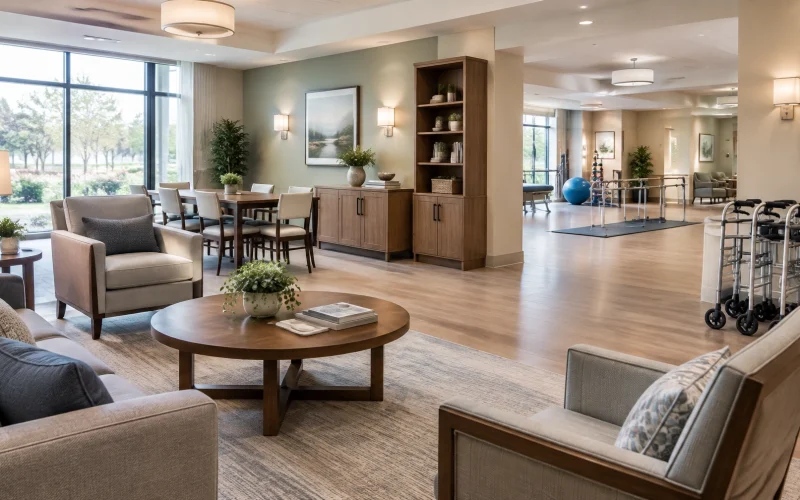
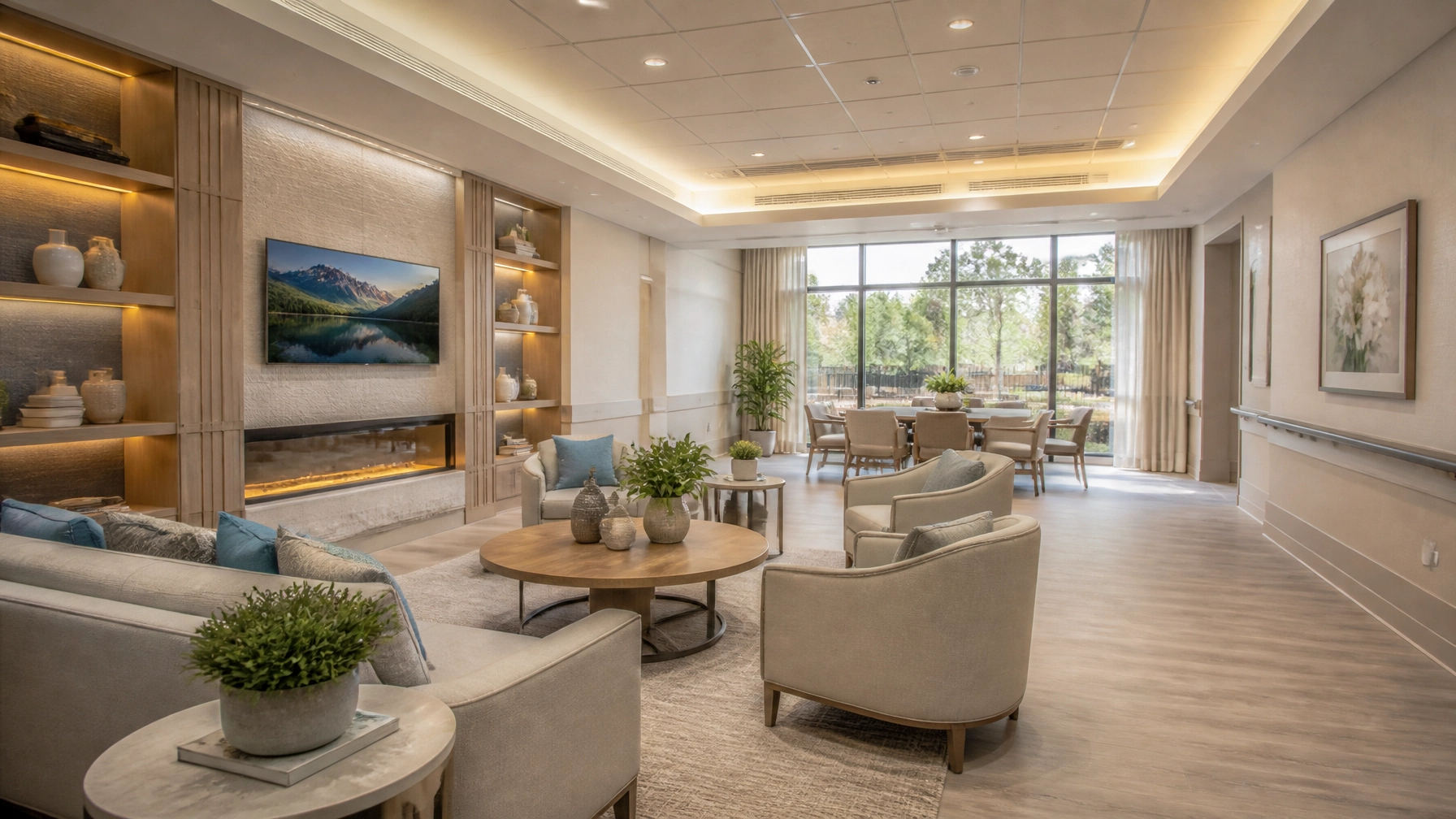
Traditional lighting standards focus heavily on horizontal illuminance (light levels on the floor or tabletops). However, elderly residents spend much of their time seated in recliners or wheelchairs while looking downward or forward. To be biologically effective, light must reach the eye. Effective assisted living interior design utilizes luminous walls, indirect uplighting, and strategically positioned wall-mounted fixtures to maximize vertical illuminance at eye level.
Establish a Dynamic Daily Profile
Work with your lighting integrator to program an automated, time-of-day control script:
- Morning (7:00 AM – 12:00 PM): High intensity, cool color temperature (5000K–6500K), delivering strong circadian stimulation to promote alertness.
- Midday (12:00 PM – 4:00 PM): Neutral color temperature (3500K–4000K) to maintain steady daytime activity.
- Late Afternoon & Evening (4:00 PM – 9:00 PM): Warm color temperature (2700K–3500K) with reduced output to signal the wind-down period and protect natural melatonin rise.
- Night (9:00 PM – 7:00 AM): Very dim, warm guidance lighting (minimizing short-wavelength content) to ensure resident and staff safety during night checks without disrupting sleep architecture.
Manage Darkness and Night Lighting
Evidence emphasizes that the management of darkness is just as critical as the management of light. Avoid harsh overhead lighting in resident rooms and corridors at night. Instead, utilize low-level, warm, indirect floor or baseboard lighting for wayfinding, preventing nighttime falls while preserving sleep continuity.
Why Circadian Lighting Matters in Senior Living Interior Design
When designing modern healthcare and residential environments, aesthetics and clinical functionality must work in tandem. Poorly integrated technology can feel clinical and sterile, defeating the warm, hospitality-driven atmosphere that prospective residents and families expect.
At Sara Roth Design, our approach to senior living interior design seamlessly embeds advanced technological systems: such as tunable circadian lighting, acoustic attenuation, and intuitive wayfinding: within elegant, residential aesthetics. We understand that every facility has unique operational requirements, user demographics, and spatial constraints.

To explore more of our insights on creating functional, enduring spaces, visit our Sara Roth Design Blog. For further guidance on optimizing your facility's environment, review our detailed analyses on 7 mistakes you're making with healthcare interior design and how to fix them and explore the ongoing industry debate on hospitality vs clinical: which is better for your nursing home.
Additionally, explore our specialized programs and marketing resources, such as our mySRD Flyer, which outlines our flexible interior design partnership models for facility owners and operators.
Conclusion
Addressing resident agitation in nursing homes and senior living facilities requires looking beyond behavioral interventions to examine the physical environment itself. Circadian lighting design bridges the gap between architectural aesthetics and clinical health outcomes. By aligning indoor lighting schedules with human biology, facility operators can dramatically reduce agitation, improve sleep quality, and foster a peaceful, supportive atmosphere for residents and staff alike.
Ready to transform your facility's environment? Partner with Sara Roth Design to deliver tailored, evidence-based interiors that enhance the human experience.